
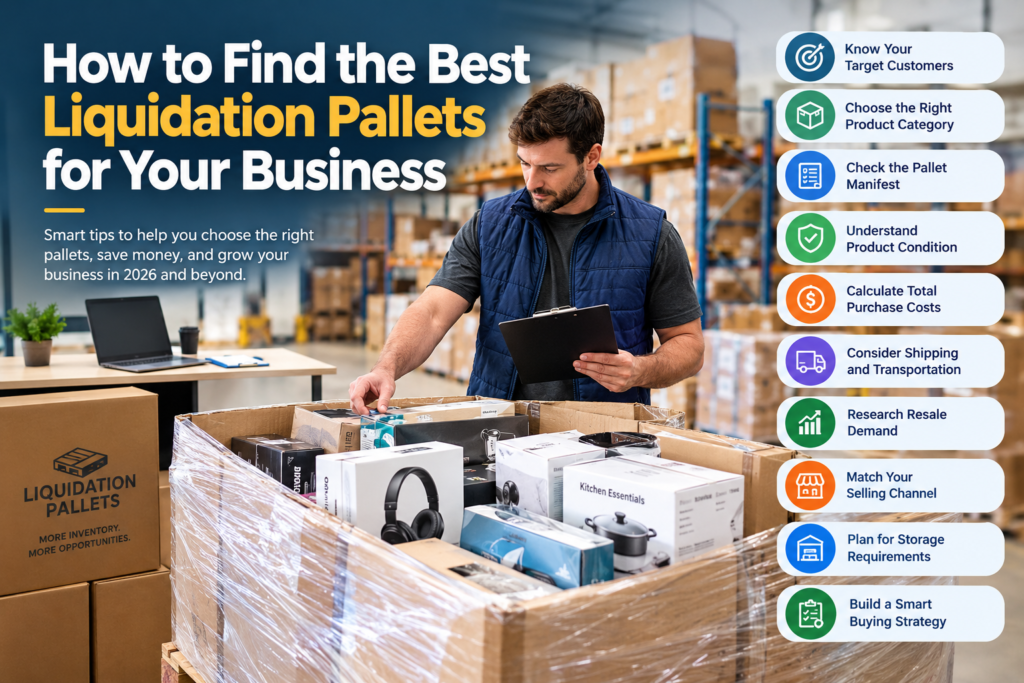
How to Find the Best Liquidation Pallets for Your Business
Finding the best liquidation pallets for your business requires more than simply looking for the lowest price. The right pallet should match your target customers, available budget, storage capacity, selling channels, and resale strategy. A pallet that looks inexpensive can become difficult inventory if the products have low demand, unexpected conditions, high shipping costs, or limited resale opportunities – Best Liquidation Pallets.
Whether you are an experienced reseller or building a wholesale business from the ground up, learning how to evaluate liquidation inventory can help you make more informed purchasing decisions. From checking the manifest and product condition to calculating your potential costs, several factors should be considered before buying – Best Liquidation Pallets.
What Are Liquidation Pallets?
Liquidation pallets are bulk collections of merchandise that businesses purchase for resale, retail, wholesale, or other commercial purposes. The inventory may come from sources such as customer returns, excess stock, overstock, discontinued merchandise, shelf pulls, or other liquidation channels – Best Liquidation Pallets.
The contents of a pallet can vary significantly depending on the supplier, category, source, and individual lot. Some pallets may contain products from a single category, while others can include mixed merchandise. This is why understanding what you are purchasing is an important part of finding the best liquidation pallets for your business.
Liquidation pallets can include categories such as electronics, apparel, footwear, appliances, home and kitchen products, tools, toys, general merchandise, and other consumer goods. The right category depends largely on what your customers are already buying and what you can realistically sell – Best Liquidation Pallets.
How to Find the Best Liquidation Pallets for Your Business
The process of finding the best liquidation pallets for your business should begin with your business model rather than the pallet itself. Before comparing individual lots, determine what type of inventory fits your operation and selling strategy – Best Liquidation Pallets.
1. Identify Your Target Customers
Your customers should influence the type of liquidation inventory you purchase. If your buyers are primarily interested in electronics, purchasing a large pallet of unrelated household products may make it harder to generate sales – Best Liquidation Pallets.
Consider what your customers already purchase from you and which categories have consistent demand. You should also consider whether your customers are looking for budget-friendly products, branded merchandise, household essentials, fashion items, electronics, or other specific categories.
Matching your inventory with customer demand can make it easier to move products after the pallet arrives – Best Liquidation Pallets.
2. Choose the Right Product Category
Once you understand your customers, narrow your search to product categories that fit your business. The best liquidation pallets for one reseller may not be suitable for another.
For example, a seller specializing in fashion may benefit from apparel, shoes, handbags, or accessories, while an electronics reseller may prefer smartphones, consumer electronics, accessories, or other technology-related inventory – Best Liquidation Pallets.
Choosing a category that you already understand can also make pricing, listing, testing, merchandising, and selling easier.
3. Check the Pallet Manifest
A pallet manifest can provide valuable information about the inventory included in a liquidation lot. When a manifest is available, review it carefully before purchasing.
Depending on the supplier and type of inventory, a manifest may provide information such as product names, quantities, estimated retail values, item numbers, brands, or other available details.
Do not rely only on an advertised total retail value. Examine the individual products and consider whether those products actually fit your customers and sales channels.
4. Understand Product Condition
Product condition can have a significant effect on resale value. Liquidation inventory may be categorized differently depending on its source and supplier.
Some lots may contain new, overstock, shelf-pull, customer-return, open-box, used, refurbished, damaged, or mixed-condition products. The exact terminology and grading system can vary between suppliers.
Before purchasing, determine what condition the merchandise is expected to be in and whether you have the resources to inspect, test, clean, repair, or repackage products when necessary.
5. Calculate the Total Purchase Cost
The advertised pallet price is not always the complete cost of acquiring inventory. When evaluating the best liquidation pallets for your business, consider every expense associated with the purchase.
Your calculation may include the pallet price, shipping, transportation, taxes or applicable fees, storage, product testing, repairs, packaging, marketplace fees, and other selling expenses – Best Liquidation Pallets – Best Liquidation Pallets.
A pallet with a lower purchase price may not necessarily provide the lowest overall cost if transportation or preparation expenses are significantly higher – Best Liquidation Pallets.
6. Consider Shipping and Transportation
Shipping can have a major impact on the economics of purchasing liquidation inventory, particularly when buying pallets or larger wholesale lots.
Before placing an order, determine where the pallet will be shipped from, where it will be delivered, the expected shipping method, and whether additional transportation arrangements are required – Best Liquidation Pallets.
Knowing your complete landed cost helps you compare different liquidation opportunities more accurately.
7. Research Resale Demand
Before purchasing a pallet, research whether there is sufficient demand for the products it contains. A pallet can have a high estimated retail value while still being difficult to sell if the products have limited demand in your market – Best Liquidation Pallets.
Research comparable products across the selling platforms you intend to use. Look at current asking prices, completed sales when available, product reviews, competition, and the general demand for the category.
The goal is not simply to find products with a high original retail price. The goal is to find inventory that you can realistically sell – Best Liquidation Pallets.
8. Match the Pallet to Your Selling Channel
Your preferred selling channel should influence which liquidation pallets you purchase. Different products may perform differently depending on where you sell them – Best Liquidation Pallets.
Some resellers use their own websites, online marketplaces, social media, physical stores, flea markets, local retail locations, or wholesale channels. Consider how easily the products can be listed, displayed, shipped, or sold through your chosen channel.
For example, large appliances may require different storage and delivery arrangements from small electronics or apparel. Understanding these operational differences can help you select inventory that fits your business.
9. Consider Storage Requirements
Storage is another important factor when choosing liquidation inventory. A pallet can contain hundreds of products or bulky items that require substantial space.
Before purchasing, determine where you will store the merchandise and whether your current facility can accommodate the shipment. You should also consider how the products will be organized after arrival.
Good inventory organization can make it easier to locate products, process orders, photograph items, and monitor stock.
10. Start With a Manageable Quantity
Buying more inventory can appear attractive when bulk pricing is available, but purchasing more than your business can handle can create unnecessary pressure on your cash flow and storage capacity.
If you are testing a new category, consider starting with a manageable quantity before committing to a much larger purchase. This gives you an opportunity to evaluate product quality, customer demand, selling speed, and overall profitability.
What Makes a Liquidation Pallet a Good Business Opportunity?
A potentially suitable liquidation pallet should fit several parts of your business at the same time. Price is important, but it is only one part of the evaluation.
The best liquidation pallets for your business should generally have products that match your customers, a condition you can work with, pricing that fits your budget, and realistic resale opportunities.
You should also consider how quickly you expect to sell the inventory. Inventory that sits in storage for a long period can tie up capital and reduce your ability to purchase new merchandise.
How to Evaluate Liquidation Pallet Pricing
When comparing liquidation pallets, avoid judging a deal based solely on the difference between the advertised price and estimated retail value.
Instead, calculate your expected costs and potential selling prices. Consider how many items are realistically sellable, the expected selling price of those items, marketplace or transaction fees, shipping to customers, preparation costs, and products that may require additional work.
This approach gives you a more practical picture of the potential economics of the pallet.
Look Beyond Estimated Retail Value
Estimated retail value can be useful as a reference point, but it does not guarantee that you will sell every product for that amount.
Retail prices, resale prices, customer demand, competition, product condition, and selling channels can all affect the amount you can actually receive.
For this reason, focus on realistic resale values rather than assuming that the original retail price represents your expected revenue.
Common Mistakes When Buying Liquidation Pallets
Buying Only Because the Price Is Low
A low pallet price can attract attention, but price alone does not determine whether a pallet is suitable for your business. Poor demand, damaged merchandise, high shipping costs, or difficult-to-sell products can reduce the value of an inexpensive lot.
Ignoring the Product Condition
Failing to understand product condition can lead to unexpected costs after delivery. Always determine whether you are buying new, returned, open-box, used, refurbished, damaged, or mixed-condition merchandise when that information is available.
Ignoring the Manifest
If a manifest is provided, take the time to review it. Understanding what you are purchasing can help you identify products that fit your business and avoid inventory that does not match your customers.
Forgetting Additional Costs
Shipping, transportation, storage, repairs, testing, packaging, marketplace fees, and other expenses can affect your final margins. Include these costs in your evaluation before purchasing.
Buying More Than You Can Sell
Large quantities can create attractive wholesale pricing, but inventory only becomes useful when you can sell it. Consider your current sales volume, storage capacity, available cash, and ability to process inventory before purchasing large liquidation lots.
Questions to Ask Before Buying a Liquidation Pallet
Before purchasing, create a checklist of questions that can help you understand the lot and reduce surprises.
- What type of products are included?
- Is a manifest available?
- What is the expected product condition?
- Are quantities confirmed or estimated?
- Are specific brands or models included?
- What is the total purchase price?
- What are the shipping or transportation costs?
- Are there additional fees?
- What selling channels are suitable for the products?
- Can the inventory be stored and processed efficiently?
How to Build a Liquidation Pallet Buying Strategy
A consistent buying strategy can help your business make better inventory decisions over time. Instead of purchasing random pallets whenever a low price appears, establish clear criteria for the inventory you are willing to buy.
Define your preferred categories, maximum purchase budget, acceptable product conditions, target resale channels, storage limits, and expected turnover period.
After selling a pallet, review the results. Look at which products sold quickly, which products remained in inventory, what expenses were higher than expected, and how the actual results compared with your initial calculations.
Use this information to improve your future purchasing decisions.
How to Find the Best Liquidation Pallets for Your Business in 2026
In 2026, businesses looking for the best liquidation pallets for your business should focus on disciplined inventory selection rather than simply chasing the largest advertised discount.
Start by understanding your customers, then choose categories that match your market. Review available manifests, understand product condition, calculate your complete acquisition costs, research resale demand, and make sure the inventory fits your storage and selling capabilities.
It is also useful to monitor changing consumer demand. Products that sell well can change over time, so regularly reviewing your sales data and market conditions can help you adjust your purchasing strategy.
Final Thoughts
Finding the best liquidation pallets for your business is a process of matching the right inventory with the right business model. The most attractive pallet is not necessarily the one with the lowest price or the highest estimated retail value.
A better approach is to evaluate the entire opportunity: product category, customer demand, condition, manifest information, purchase price, shipping, storage, selling costs, and realistic resale potential.
When you take the time to evaluate these factors before buying, you can make more informed inventory decisions and build a liquidation sourcing strategy that supports the long-term growth of your business.